The Great Australian Circuit
 This week was a great one for me, and yet another highlight this chapter in our lives draws to an end. Late last year a new President was appointed at Boeing Australia, who is one of my many bosses. David Withers is young, energetic and wants to make a real impression in his new role. So this week he and his nine person Executive Council, of which I am a part, took a whirlwind tour around Australia to visit Boeing’s sites and the people who work there. Due to the unique distances and locations we were to visit, we chartered two Westwind biz jets that zipped us around the continent at 36,000 feet. On Sunday afternoon we took off at 3PM and headed for a fuel stop at Alice Springs, in the middle of the continent. During the flight we were treated to views of the great Australian outback, with giant red mountains of sand and unique patterns of dunes created by wind and water. During the summer months, as heavy rains fall in northern Australia, water overflow runs to central Australia where it brings new life to the dessert. We were able to see several of the large lakebeds, some with water remaining from the summer rains.
 Central Australia from the air as we near Alice Springs.
 Our first stop on the trip was Exmouth along the Australian Northwest Cape. In 1968 the US Navy built a Very Low Frequency (VLF) communications site in the middle of nowhere. Today it is the largest VLF site in the world. Tower Zero shown on the right is a quarter-mile high and the building at the bottom has a footprint larger than a football field. The site was named Harold E Holt, named after the former Australian Prime Minister who mysteriously vanished off the Victoria coast during a normal morning swim. All sorts of explanations surround the disappearance of Prime Minister Holt, from Japanese subs kidnapping him to a shark attack. The most likely cause I reckon was the strong rip tides which occurred in the region. It is interesting that an Australian Prime Minister was lost at sea, but yet did any of you Americans know that part of Australian history? I know I didn’t until moving here. Can you imagine what history would have said if an American President mysteriously disappeared while going for a morning swim? Just goes to show you how outta touch we are. Anyway, the Exmouth Naval Communications site was handed over to the Australians in 1992 to run, and Boeing Australia now has the contract to run it, which takes over 100 people. It boasts 13 large transmission towers, with the largest Tower #0 reaching 1,271 ft shown above. The antenna arrays use 400 km of copper wire, with the largest Tower 0 weighing 800 tons, all of which rests on a single ball joint designed to support seven million pounds which
  can occur when cyclones hit. Six 3 million watt special purpose diesel generators create enough power to not only support the 2 Megawatt transmitter, but also supply power for the entire 2,000 person township. Everything about this site is massive, and it is like nothing I have ever seen before. The transmissions are used to communicate with US nuclear submarines around the world. Due to the unique characteristics of low frequency radio waves, these are the only transmissions that can be received by submarines when they are below surface. When originally built in 1968, Exmouth was a little piece of America in Australia. The population was largely US military, with US cars with left side steering wheels. Exmouth is now famous for tourism, with great fishing and a world class reef that no one hears about called the Ningaloo Reef. Unlike the Great Barrier Reef, which is about 2 hours from shore via boat, the Ningaloo Reef is easily accessible from shore. You just walk out and BANG, there it is. Above is a picture I took at 35,000 feet out the right hand side of the plane where you can see the reef offshore. This year is whale shark season, when the annual migration of whale sharks by the Ningaloo Reef takes place. These large but harmless plankton feeders come cruising by very close to shore. It is one of the few places in the world where you can snorkel with these giants. Aerial planes spot them swimming near the surface in the crystal clear water, and radio direction and location to the tour boats waiting. The boats then position themselves in front of the whale sharks then have spectators jump in the water just before they arrive. I am told by people who have done it that it is truly an incredible event to see. Unfortunately I did not have enough time to see them, and it was a bit early in the season.
Co-workers Rick and Charlie on left and ride, with my Australian boss David in the middle.
 My co-worker Wayne Needs checks out the power panel at the Exmouth power generating station.

Marc and pilot Mal pose before take-off at Learmont airport, near Exmouth.
After two days in Exmouth we flew to Geraldton on Wednesday morning, where Boeing has a contract to operate a classified site for the Australian Government. Geraldton is located at the same latitude as Brisbane, and hence has a similar climate with 3 distinct seasons- Summer Cool, Summer Paradise and Summer Hot. Like Brisbane Summer Paradise is about 8 months of the year, with the remaining 4 months being split between Summer Cool and Summer Hot. Being on the west coast it is not as humid as Brisbane, which is good in Summer Hot Season when the temps can reach 115 degrees. It was a pleasant 80 degrees during the day when I was there and 65 degrees at night. Typical Summer Paradise season weather. Geraldton is a town of about 50,000 people which I actually preferred to the too small Exmouth at 2,000 people. They had a “Mackers” (McDonalds), Bunnings (Home Depot) and Target. Real estate is probably some of the most affordable I have seen in Australia for coastal property, but that is changing due to the mining money flowing into town from central Western Australia. At halfway up the Western Australia coast, Geraldton is the last town on the Western Australia power grid. All towns north have their own power generating stations, typically diesel, like Exmouth. We were able to stop and visit the memorial for the HMAS Sydney II, an Australian warship which was sunk off the Geraldton coast by a German U-boat in WWII. All 627 crewmembers were lost and the location of the ship has never been determined.
 Geraldton from the cockpit as we approach the airport.
Thursday night we boarded our small biz jets and zoomed off the Northern Territory town of Darwin. Darwin has quite a history, and was actually bombed by the Japanese during WWII. Being on the north coast of Australia Darwin is smack in the middle of the tropics and you can feel it in the air. Lush forests surround the town and a heavy humidity was there even in May. Cyclone Tracy struck Darwin on Christmas Eve 1974 and stalled over the town, virtually destroying every building in town. The town was a “shanty town” and was not built for cyclones, so most of the town was literally flattened. I saw a picture of the town and it looked similar to tornado paths in the Midwest – except the path here was about 50 km wide! Officially the death toll was around 50 people; unofficially it was more like 2,000. The 1,950 people not in the official death toll were native Aborigines, who have a significant presence in Darwin. The actual death toll has been classified and will be made public in 50 years per Federal law. It is interesting that the Northern Territory is indeed still a territory rather than a state. What that means is that, like every Australian citizen, they are required to vote in every election. In Australia the States have more rights than the Federal Government, which is the opposite from the US. So if there is a conflict between State and Federal government laws, the State wins. But in a territory the Feds laws overrule territorial laws. The net result is that there is a growing state movement in the Northern Territory, and you can expect to see a popular vote in about five years making Northern Territory a State. The other interesting thing about the Northern Territory are the  salt water crocs which live here. They are interesting and very scary. Several of the people I met have had “close calls” with these masters of death. They grow up to 20 feet in length and are a smart, predatory animal. Because they were going extinct after a hunting campaign, the Federal government has protected them and encouraged their comeback. The net result is that they are spreading down the Queensland coast and have been sighted as close as Hervey Bay, only four hours north of Brisbane by car. Pretty scary. Our only close call came when our bus to the airport broke down and we had to offload our luggage and wait for a new bus. Above are my colleagues waiting for the new bus. Note the lush vegetation in the background.
I write this final text of this blog entry from 37,000 feet at 9:30PM Friday night as our plane  travels over the great, dark Australian outback. Our plane is gently weaving through large thunderstorms which I can see both outside the plane and on our cockpit weather radar screen. One of the great things I appreciate about my job with Boeing is the opportunity to travel around the world for business and meet people from different cultures. This trip ranks up there with the best of any of my previous trips – Russia, Brazil, Kiribati, and Samoa. I am blessed to have had the opportunity to take this trip just a few weeks before our return to the U.S.
Marc

 On Tuesday 1 May I had a really neat experience that was uniquely Australian. A friend and former colleague of mine, Brendan Croucher (right), invited me to fly to Central Queensland to speak to a mining company's leadership team about how we lead large-scale projects at Boeing. Brendan works with them in the organisational development area. We lifted off at 5:50 AM from Brisbane in a small QantasLink Bombardier Dash 8 aircraft filled almost entirely with people working coal strip mines near Moura, Queensland.
  One could tell that these are the guys making the Big Money with resources from what Donald Horne called "The Lucky Country" in his famous 1964 book. While there is some debate if he was serious when he coined Australia the "lucky" country, today many people agree that he was serious and that it now refers to the many blessings Australia has to offer, not the least of which is the plentiful supply of minerals. As an example, Australia boasts huge resources of coal and natural gas. Interestingly 98% of the worlds opals come from Australia.
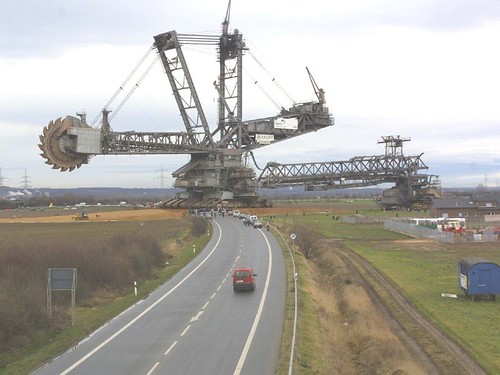
 After 70 minutes of flying into the centre of Queensland, we landed at the Biloela airport, one of the smallest commercial airports I have seen. We drove 45 minutes to the mine site, traveling through country that reminds me of our family's cattle ranch in southeastern Montana. Rolling hills, grassy flatlands, clear blue sky and lots of cattle. The weather was about 80 degrees. Once arriving at the mining site, I soon appreciated that everything is big in mining. Very big. The size of the machinery they use is incredible. I received my mandatory safety briefing, "flouro" safety vest, and was off to meet the Anglo Amercian Coal Company leadership team. I met for 3 hours with 10 of their leaders, including their General Manager David O'Rourke. It was interesting how different their industry was, but how their problems were very similar. We spoke quite some time about program metrics, and how we can define them to be true performance indicators. I showed them some neat videos of the products we produce at Boeing. They were a great group of people, and I am confident they will continue to improve the culture at this mine site. After a hearty lunch, Brendan and I were treated to a tour by a young, red-headed female mining engineer named Verity, who truly loved mining and the Queensland outback way of life. We saw drag lines, mining shovels, mining trucks, and the conveyor belt that was part of a one billion dollar upgrade program. Its one of those things you have to see to believe- the size of the machinery and escavation is breathtaking. Another part of their upgrade was a wash plant where they can wash the coal to various grades, depending on the user requirements. Most of the coal in Australia goes to Asia, and from this site to Japan. Between Japan and China, they have an almost insatiable appetite for Australian black gold. After the tour Brendan and I drove back to the airport to fly home. While waiting for the plane to arrive, we laughed at the white truck with